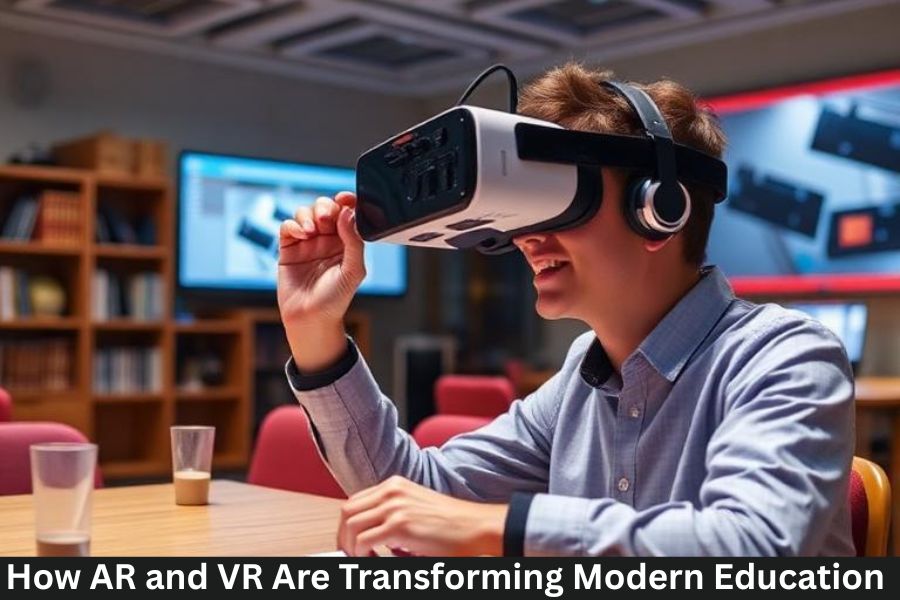
Technology is rapidly reshaping the education sector, and two of the most exciting innovations are Augmented Reality (AR) and Virtual Reality (VR). These immersive technologies are changing how students learn, interact, and understand complex concepts. From virtual classrooms to interactive simulations, AR and VR are transforming modern education in powerful ways.
In this SEO-optimized article, we explore how AR and VR are revolutionizing teaching methods, enhancing student engagement, and preparing learners for the future.
What Are AR and VR in Education?
Augmented Reality (AR) overlays digital content—such as images, animations, or data—onto the real world using devices like smartphones or tablets.
Virtual Reality (VR) creates a fully immersive digital environment that students can explore using VR headsets.
While AR enhances real-world experiences, VR replaces the physical environment with a simulated one. Both technologies are increasingly being adopted in schools, colleges, and universities worldwide.
1. Enhancing Student Engagement
One of the biggest challenges in education is maintaining student attention. Traditional lectures can sometimes feel passive and less interactive. AR and VR make learning more engaging by turning lessons into immersive experiences.
For example:
- Students can explore historical landmarks virtually.
- Biology learners can interact with 3D human anatomy models.
- Science students can conduct virtual experiments safely.
Immersive learning captures attention and improves knowledge retention.
2. Experiential Learning Through Virtual Simulations
AR and VR allow students to experience real-life scenarios without leaving the classroom.
With VR, learners can:
- Visit space stations
- Travel back in time to ancient civilizations
- Practice medical procedures in simulated environments
- Conduct chemistry experiments safely
Experiential learning helps students understand practical applications of theoretical knowledge, making education more meaningful and effective.
3. Improving Understanding of Complex Concepts
Some subjects involve abstract or difficult concepts that are hard to visualize through textbooks alone. AR and VR make these concepts easier to grasp.
For instance:
- Engineering students can view 3D models of machinery.
- Physics students can visualize atomic structures.
- Architecture students can walk through digital building designs.
Interactive visualization makes learning clearer and more comprehensive.
4. Safe Learning Environment
Certain training programs—such as medical, aviation, or engineering—require hands-on practice that may involve risks. VR provides a safe, controlled environment where students can practice without real-world consequences.
Examples include:
- Surgical simulations for medical students
- Flight simulators for pilot training
- Emergency response training for disaster management
This reduces risks while building confidence and skills.
5. Personalized Learning Experiences
AR and VR technologies support personalized learning by adapting content based on individual student needs. Students can learn at their own pace and revisit simulations as needed.
Benefits include:
- Self-paced learning
- Immediate feedback
- Customized educational content
- Enhanced accessibility for different learning styles
This flexibility improves academic performance and student satisfaction.
6. Global Virtual Classrooms
VR technology enables virtual classrooms where students from different parts of the world can interact in a shared digital environment.
This encourages:
- Cross-cultural collaboration
- Remote learning opportunities
- Global knowledge exchange
- Enhanced communication skills
Virtual classrooms became especially valuable during online learning transitions, showing how immersive technology can bridge geographical gaps.
7. Supporting Special Education
AR and VR tools are also helping students with learning disabilities or special needs. Interactive and visual learning methods can make content more accessible and easier to understand.
For example:
- AR apps can assist students with reading difficulties.
- VR environments can help children with social anxiety practice communication skills.
- Interactive visuals can improve focus and comprehension.
Inclusive education becomes more achievable with immersive technology.
8. Boosting Motivation and Creativity
Gamified AR and VR learning environments make education fun and interactive. Students feel more motivated when lessons feel like experiences rather than tasks.
Creative subjects benefit significantly:
- Art students can create 3D sculptures digitally.
- Design students can experiment with virtual prototypes.
- History students can recreate historical events.
Creativity flourishes in immersive environments.
9. Preparing Students for Future Careers
Many industries—including healthcare, engineering, architecture, and entertainment—are integrating AR and VR technologies. Exposure to these tools in education prepares students for future careers.
By learning with immersive technology, students develop:
- Technical skills
- Problem-solving abilities
- Digital literacy
- Adaptability to emerging technologies
Modern education must align with industry demands, and AR/VR plays a key role in this transformation.
10. Challenges of Implementing AR and VR in Education
Despite the benefits, there are challenges:
- High initial investment in equipment
- Technical infrastructure requirements
- Need for teacher training
- Limited access in developing regions
However, as technology becomes more affordable, adoption rates are increasing steadily.
The Future of AR and VR in Education
The future of AR and VR in modern education looks promising. With advancements in artificial intelligence and 5G connectivity, immersive learning experiences will become more accessible and interactive.
In the coming years, we can expect:
- More affordable VR headsets
- AI-powered adaptive learning systems
- Enhanced real-time collaboration
- Fully immersive digital campuses
Educational institutions that adopt AR and VR early will lead the way in innovative teaching and learning practices.
FAQs About AR and VR in Education
1. How are AR and VR used in education?
They are used for virtual simulations, interactive lessons, 3D visualizations, virtual field trips, and skill-based training programs.
2. Is VR better than traditional classroom learning?
VR enhances learning by making it immersive and interactive, but it works best when combined with traditional teaching methods.
3. Are AR and VR expensive for schools?
Initial costs can be high, but prices are gradually decreasing, making the technology more accessible.
4. Can AR and VR improve student performance?
Yes, immersive learning improves engagement, retention, and understanding, which can positively impact academic performance.
5. What subjects benefit most from AR and VR?
Subjects like science, medicine, engineering, architecture, history, and geography benefit significantly from immersive technologies.